
The ART Framework: Get Recommended by AI Search in 2026
Search has changed. When someone asks Google, ChatGPT, or Perplexity for recommendations, they don’t get ten blue links anymore – they get a direct answer with two or three businesses mentioned by name.
The question is: will your business be one of them?
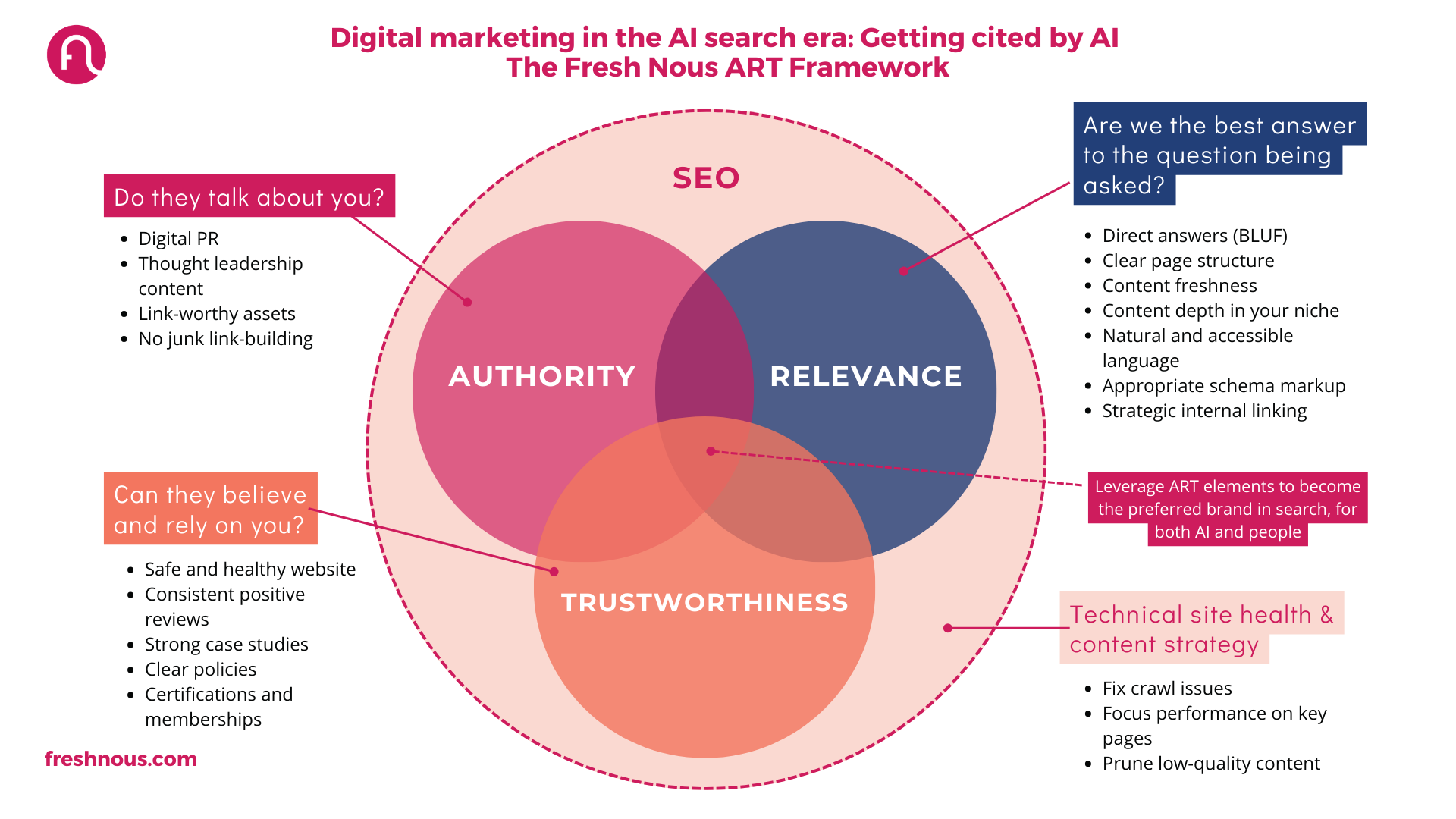
Traditional SEO still matters – Google needs to crawl and understand your site – but it’s no longer enough. AI-powered search tools are now deciding which businesses are worth recommending, and they’re looking for three specific signals: Authority, Trust, and Relevance.
At Fresh Nous, we call this the ART Framework. Here’s how it works.
What is AI looking for when it recommends businesses?
AI doesn’t just scan your website and pick the best-written content. It cross-references multiple signals to decide if you’re credible, safe, and genuinely useful.
Think of it like this: if AI were a cautious advisor helping someone choose a supplier, what would it check? It would look for evidence that you’re respected in your field, that you’re legitimate and proven, and that you actually answer the specific question being asked.
That’s Authority, Trust, and Relevance – the three pillars that maximise your chances of being featured or cited by AI tools in their recommendations.
Authority: Do credible sources talk about you?
Authority isn’t about what you say about yourself. It’s about what others say about you.
AI looks for external validation: mentions in trade publications, features in industry roundups, links from respected websites, and references from credible third parties. The more often your business appears in trusted contexts, the more AI sees you as an established name worth recommending.
This is where digital PR becomes essential. A single feature in a respected trade publication can carry more weight than a dozen blog posts on your own site. Why? Because AI recognises that external mentions are harder to manufacture than self-promotion.
The businesses winning in AI search aren’t necessarily the biggest – they’re the ones being talked about in the right places.
Trust: Can you be believed?
AI is cautious by design. It won’t recommend businesses that feel risky, vague, or unproven – and “trust” signals are surprisingly straightforward.
Real reviews matter. A business with 100+ Google reviews and thoughtful responses to criticism looks more trustworthy than one with three generic five-star ratings. Case studies with specific outcomes, named clients (where possible), and measurable results all build credibility.
Visible expertise helps too: team profiles showing real people with real credentials, industry memberships, accreditations, and transparent contact information all signal legitimacy. Even website security – an SSL certificate, up-to-date plugins, clear privacy policies – contributes to the overall trust picture.
The pattern is simple: show the evidence, don’t just make the claims.
Relevance: Are you the best answer to this specific question?
This is where most businesses fall short. Your website might explain what you do, but does it answer what people are actually searching for?
AI rewards specificity. A page titled “Fire Safety Solutions” is vague. A page answering “How often should emergency lighting be tested in a commercial warehouse?” is precise, useful, and far more likely to be cited.
The mechanics of relevance are surprisingly practical: structure content around real customer questions, put the answer first (don’t bury it three paragraphs down), keep information current with visible dates, and write in plain language rather than internal jargon.
One final detail: AI notices when content is stale. An article from 2019 with no updates suggests your expertise might be outdated. Fresh examples and recent updates signal you’re still active and relevant.
Why this framework matters now
Most businesses are still optimising for traditional search – keywords, meta tags, backlink counts. That foundation still matters, but it’s no longer the deciding factor.
The businesses that will dominate visibility in 2026 and beyond are the ones building deliberate Authority, Trust, and Relevance strategies. They’re getting featured in trade press, collecting genuine reviews, publishing case studies, and creating content that directly answers customer questions.
The shift is already happening. The only question is whether you’ll adapt early or play catch-up later.
How to start using the ART Framework
You don’t need to overhaul everything overnight. The most effective approach is simple: pick one action from each pillar and commit to completing them in the next 90 days.
One Authority action (a feature, a partnership mention, a quality external link), one Trust action (reviews, a case study, visible credentials), and one Relevance action (content that answers a real customer question).
That’s it. Three actions. Ninety days.
If you want to go deeper – or if you’re not sure where your biggest gaps are – we’ve built a detailed checklist covering all three pillars with specific, actionable steps. Access it using the form below.