We recently saw an advert claiming that AI can replace an entire marketing team for the price of Netflix. It promised ads, videos, and posts in minutes, with “no team, no stress, no delays, no overthinking”.
On the surface, it is exactly the kind of message that will appeal to busy business owners. Marketing can feel time-consuming, expensive, and difficult to keep on top of, so the idea of having everything created instantly by AI sounds tempting. For a small business owner spinning lots of plates, it’s easy to see why that promise would catch attention.
But there was one very obvious problem with the advert: the word marketing was spelt wrong, along with a few other basic grammatical errors. In an advert about replacing marketing teams.
It is a small mistake, but it makes a much bigger point. AI is an incredibly useful tool, and there is no doubt that it can support modern marketing in lots of valuable ways. But what it cannot do is replace the human brain behind the work.
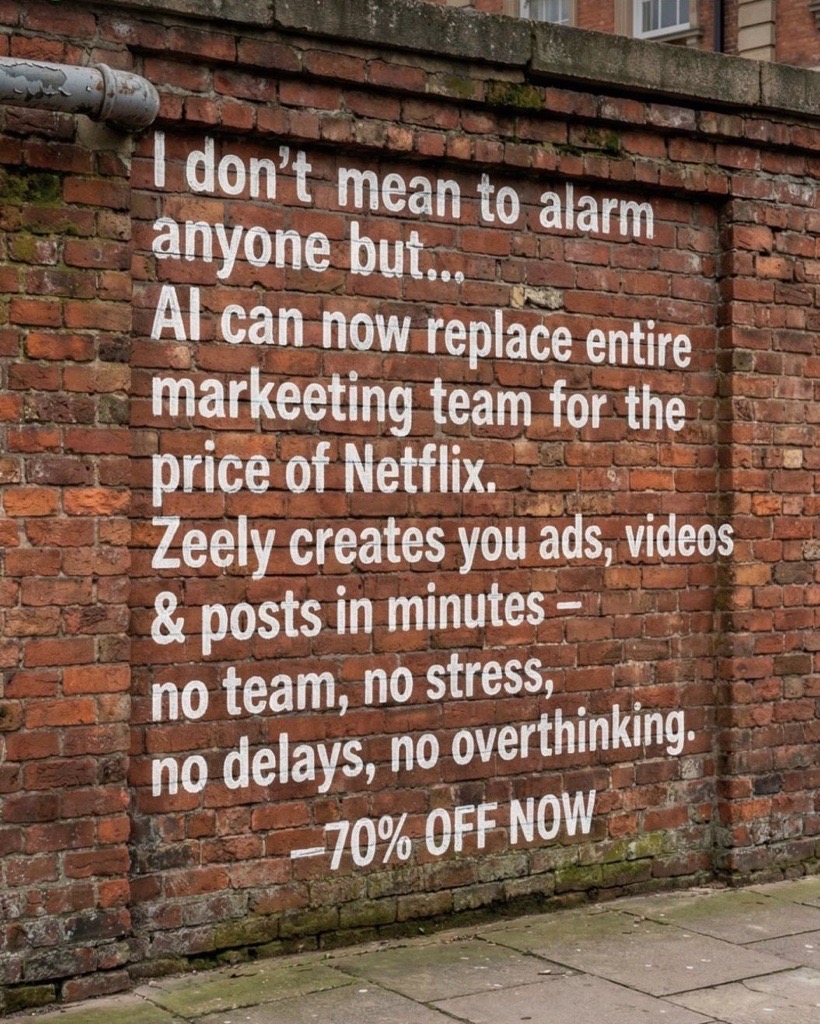
Image credit zeely.app
Using AI as a Tool
Think of AI like a pen. A pen is a tool. An extraordinarily useful one. But without a person who knows what to write, why they are writing it, and who they are writing it for, it is just an object sitting on a desk. AI is the same. It is a tool that can speed up the execution of ideas, but it still needs the thinking, judgement, and quality control that only a human can provide.
Used well, AI can make a marketing team quicker, sharper, and more efficient. We use AI ourselves, and we see huge value in it when it is guided properly. The issue is not AI itself. The issue is the idea that AI can simply replace the strategic thinking and editorial oversight that good marketing requires.
Where Can AI Help Marketing Teams?
There are real, practical things AI does brilliantly, but the value is in knowing where to apply it rather than assuming it can do everything.
It’s excellent for getting started when you are staring at a blank page. Sometimes the hardest part of any piece of marketing is the first sentence, and AI can give you a strong enough structure to work with, react to, and improve, which is far easier than starting from nothing.
It’s also a useful starting point for desk research. If you need a quick overview of a topic, a sector, or a competitor landscape before a campaign kicks off, AI can pull together a useful summary in minutes. You still need to verify what it produces and apply your own judgement, but it can dramatically reduce the groundwork.
Template tools are another area where AI adds real value. Tracking spreadsheets, campaign budget plans, content calendars, reporting frameworks: these are the kind of structured, repeatable documents that AI can generate a solid first version of, leaving your team to adapt and refine rather than build from scratch every time.
And perhaps one of the most underused applications is as a knowledge repository. You can deposit technical documents, brand guidelines, audience research, product specs, or briefing notes into an AI tool and then pull from that information quickly when you are writing content, building campaigns, or briefing a team. At Fresh Nous, we use features like this within our own workflows, and the time-saving when creating consistent, accurate content is significant.
What AI Cannot Replace
Marketing isn’t just about producing more content. Good marketing needs context. It needs audience understanding. It needs a clear sense of what the brand stands for and how it should show up in the world. It also needs someone who can look at the final output and ask: is this right? Does it sound like us? Will this land with our audience?
That human check matters. And it matters more than most people realise, because AI is not just occasionally wrong. It is confidently wrong.
This is the part that catches people out. AI does not flag uncertainty. It does not say “I am not sure about this; you might want to check.” It generates an answer and presents it with the same tone and fluency whether the information is accurate or completely fabricated. There is a term for this: hallucination. But that word makes it sound almost whimsical, when the reality can be much more damaging.
Imagine a piece of content that cites a statistic that does not exist. Or a product description that quietly misrepresents a specification. Or a thought leadership article that references a piece of research that is being quoted inaccurately. Each of these things can happen, and none of them will be signalled by the AI. The output will look exactly like every other output it produces; fluent, formatted, and completely plausible.
The risk is not that AI will obviously fail. The risk is that it will fail in a way that is easy to miss, especially if the person reviewing it does not have the subject matter knowledge to spot the gap.
This is why the “AI instead of people” argument is not just commercially questionable. It is genuinely risky for brands that care about accuracy, credibility and trust.
What Should You Do?
Start by being clear about where AI earns its place in your toolbox and where it needs a human alongside it. In our experience, the best results come when AI is used to move faster through the work that would otherwise slow a team down: first drafts, research summaries, template documents, campaign structures. That frees up human time for the work that genuinely requires it: strategy, audience insight, quality control, and the judgement calls that no tool can make for you.
At Fresh Nous, we work with clients to build this kind of approach into their marketing process. Not as a one-off experiment, but as a way of working that is repeatable, reviewable and sustainable. We turn insight into action, and that means knowing which tool is right for which job.
AI is not going away. Neither is the need for good human judgement. The businesses that get the most from both are the ones that treat them as a combination rather than a competition.
And if you are ever unsure whether your AI-generated content is ready to go? Read it again. Carefully. Check the facts. Check the tone. Check it sounds like your brand.
And check the speelling 😉